

Project-Based Learning
Project-based learning is a hot topic in education. With the adoption of common core curriculum and the Next Generation Science Standards, there is a big push to give students authentic and meaningful tasks with which they can apply a variety of skills. This makes perfect sense and some credit must be given to cognitive science. The cognitive science revolution of the past 20 years has given us so much knowledge on how people learn best. How our brains connect new knowledge to existing knowledge is part of this cognitive science revolution. Giving students relevant experiences that connect to things they already hold in their brains increases the chances that they will develop a conceptual understanding of a topic (rather than just a procedure) and also greatly increases the possibility that students can apply the learning to other things.
Ok, enough about the brain science......let's talk about what project based learning is. Project based learning begins with an authentic task; something meaningful that will pic the interest of the students.

I recently developed a project-based activity for upper elementary where students are tasked with developing a dog park. They design different areas of the dog park, such as grass, bark, pea gravel, and then calculate the costs for these materials based on the area of each section. They also work on perimeter as they select fences and gates for their park. As they apply math skills, they are also working on collaborative skills while they work in a team. They write letters to city council members and culminate the project with a presentation detailing their budget and dog park proposal. The requirements of the project take place over the course of several days in the classroom. Students are invested in the activity and engagement soars. Creativity is encouraged as each team creates their own version of a dog park. When the project concludes, they've had the opportunity to apply a variety of math and language skills to a project they won't soon forget. I'd love to hear your thoughts on project-based learning. Have you tried it before? What was the response from students?
Ok, enough about the brain science......let's talk about what project based learning is. Project based learning begins with an authentic task; something meaningful that will pic the interest of the students.
I recently developed a project-based activity for upper elementary where students are tasked with developing a dog park. They design different areas of the dog park, such as grass, bark, pea gravel, and then calculate the costs for these materials based on the area of each section. They also work on perimeter as they select fences and gates for their park. As they apply math skills, they are also working on collaborative skills while they work in a team. They write letters to city council members and culminate the project with a presentation detailing their budget and dog park proposal. The requirements of the project take place over the course of several days in the classroom. Students are invested in the activity and engagement soars. Creativity is encouraged as each team creates their own version of a dog park. When the project concludes, they've had the opportunity to apply a variety of math and language skills to a project they won't soon forget. I'd love to hear your thoughts on project-based learning. Have you tried it before? What was the response from students?
Science Notebooks Are Valuable
I've been away for a while for a variety of reasons.....but with this fresh look, I am going to make time to get on here and blog more often. A HUGE shout out to Jolene from Paisley n' Polkadots Blog Designs for working with me to create this fun blog design. She was amazing to work with!
My topic for today is science notebooks. Science notebooks are such a terrific way to organize your students' learning as well as provide resources and tools to help them practice science as scientists as well as review for tests. Letting students take ownership of their science notebooks can be a huge source of pride and motivation for students.
Benefits for teachers include accountability and grading, not having to give students the same information over and over (Go look in your science notebook!), as well as having motivated and engaged students.
There really are no rules for science notebooks. Many traditional interactive notebook gurus have very systematic ways of keeping the notebooks such as odd pages are for vocabulary, even are for things you glue in, a table of contents in the front etc. I prefer to leave the notebook a little more open ended and creative. I provide papers and resources to be included in the notebook, but I allow students to be creative on how they set the notebook up. It's up to you!!!
Click here for a freebie to help you get science notebooks started in your classroom. Print off different colored covers for different groups if you like, or let your students choose. Included in this freebie are covers, science safety pages (you never can stress safety enough!), and scientific process guides and templates. These can be copied and used over and over. Students can glue pages into a regular sized notebook, or shrink them down to 80% if you prefer the composition book. So get going on preparing notebooks for your students to get ready for the next school year! You won't regret it!
My topic for today is science notebooks. Science notebooks are such a terrific way to organize your students' learning as well as provide resources and tools to help them practice science as scientists as well as review for tests. Letting students take ownership of their science notebooks can be a huge source of pride and motivation for students.
Benefits for teachers include accountability and grading, not having to give students the same information over and over (Go look in your science notebook!), as well as having motivated and engaged students.
There really are no rules for science notebooks. Many traditional interactive notebook gurus have very systematic ways of keeping the notebooks such as odd pages are for vocabulary, even are for things you glue in, a table of contents in the front etc. I prefer to leave the notebook a little more open ended and creative. I provide papers and resources to be included in the notebook, but I allow students to be creative on how they set the notebook up. It's up to you!!!
Click here for a freebie to help you get science notebooks started in your classroom. Print off different colored covers for different groups if you like, or let your students choose. Included in this freebie are covers, science safety pages (you never can stress safety enough!), and scientific process guides and templates. These can be copied and used over and over. Students can glue pages into a regular sized notebook, or shrink them down to 80% if you prefer the composition book. So get going on preparing notebooks for your students to get ready for the next school year! You won't regret it!
Engaging Hands On Science Lesson....Free Resource For You!
I appreciated the feedback on my last blog post. I wanted to hear from teachers about what their obstacles were to teaching science. A few common themes surfaced: Overwhelmingly time is an issue. Teachers don't feel like they have time to squeeze science into their already packed days. The other issue was resources. Science is a resource heavy subject to teach; especially if you're going to do it right. With these obstacles in mind, I hope to give teachers some resources and tips for bringing science back.
So today, I want to share a lesson idea for science that is engaging, fun, light on resources, and can be integrated with other subjects. So here it is:
So today, I want to share a lesson idea for science that is engaging, fun, light on resources, and can be integrated with other subjects. So here it is:
THE RAINBOW CHALLENGE
For this lesson, students will investigate acids and bases using a Cabbage Juice Indicator. It's super simple to make, but might be a little stinky. Check out the directions here.
Once you get it made, store in mason jars and put extra in your freezer. It lasts a long time! Students will be using the cabbage juice to test different substances to see if they are acids or bases. No fancy science equipment is required. Using wax paper with a paper guide placed underneath works great. You can also use a paint tray that has many small concave circles for this.
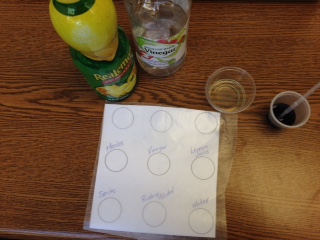
Next, you need some everyday items to test. It's always great to have a variety of liquids or solids that will show a variety of colors. Some suggested items: vinegar, lemon juice, Maalox, milk, sprite, baking soda, seltzer water, rubbing alcohol, or just about anything. Students will be mixing a small amount of Cabbage Juice Indicator with each of the liquids or solids. They are to take note of color change and compare it to the ph Chart. The ph chart for cabbage indicators is slightly different than the scientific chart. Here's some pictures for comparison:


As you can see from the above pictures, the Cabbage Juice Scale goes from 1 to 12, while the PH Scale goes from 1-14. The closer to 1, the more acidic. Around 7 is neutral, and 12/14 is very basic.
Use this free resource link to access student activity sheets and data collection papers. Discussion prompts and connections to other areas of the curriculum are included. Students LOVE this activity. It connects to chemical changes and also to the scientific process. End the lesson by making real world connections to acid rain. An integrated writing idea is included.
Have a great week, everyone! If you get a chance to do this activity, leave some feedback as to how it went.
Use this free resource link to access student activity sheets and data collection papers. Discussion prompts and connections to other areas of the curriculum are included. Students LOVE this activity. It connects to chemical changes and also to the scientific process. End the lesson by making real world connections to acid rain. An integrated writing idea is included.
Have a great week, everyone! If you get a chance to do this activity, leave some feedback as to how it went.
Let's Bring Back Science!!!
Hello Everyone!
Post number 2...here we come. My focus for today is on getting the conversation started. Not a one-way conversation where I type, you read, and that's it. We need some interaction!
I did some extensive research in my doctoral program around elementary science. The first thing I learned is that it just isn't happening. According to the latest report from Horizon Research (Report available here), science is taught an average of 1.5 hours per week for K-3 students and 2 hours per week in grades 4-6. Compare this to Math (4.5 hours for K-3, and 5 hours for 4-6) and Language Arts (7.5 hours for K-3 and 7 hours for grades 4-6), and you have to wonder what we can do to find a better balance for our students. Young students find science engaging and exciting. Why can't we find ways to integrate the subjects so that we don't leave science out and deprive our students?
Last week, my first introductory blog, left me with many likes but no comments. I'd like to ask you to comment today and give feedback as to what the obstacles are for teaching science. If we can identify the obstacles, we have somewhere to start. My hope for this blog is to find workable solutions for teachers. If we can identify the problems, we can tackle solutions from there. I have lots of great ideas to work science into the elementary day. But this needs to be a community effort! So chime in please!
I'd also like to include some easy access resources on this blog. I'll be trying to figure out how to link you to various resources on this blog, so check out the bottom and sides for links to investigate. This blog is new; so any input/suggestions are greatly appreciated!
Post number 2...here we come. My focus for today is on getting the conversation started. Not a one-way conversation where I type, you read, and that's it. We need some interaction!
I did some extensive research in my doctoral program around elementary science. The first thing I learned is that it just isn't happening. According to the latest report from Horizon Research (Report available here), science is taught an average of 1.5 hours per week for K-3 students and 2 hours per week in grades 4-6. Compare this to Math (4.5 hours for K-3, and 5 hours for 4-6) and Language Arts (7.5 hours for K-3 and 7 hours for grades 4-6), and you have to wonder what we can do to find a better balance for our students. Young students find science engaging and exciting. Why can't we find ways to integrate the subjects so that we don't leave science out and deprive our students?
Last week, my first introductory blog, left me with many likes but no comments. I'd like to ask you to comment today and give feedback as to what the obstacles are for teaching science. If we can identify the obstacles, we have somewhere to start. My hope for this blog is to find workable solutions for teachers. If we can identify the problems, we can tackle solutions from there. I have lots of great ideas to work science into the elementary day. But this needs to be a community effort! So chime in please!
I'd also like to include some easy access resources on this blog. I'll be trying to figure out how to link you to various resources on this blog, so check out the bottom and sides for links to investigate. This blog is new; so any input/suggestions are greatly appreciated!
And Just like that.....My Blog is Born!!
Now that I have a little time on my hands (yeah, right!), I've decided to continue my quest to improve teaching and learning. Through this blog I hope to share teaching ideas for science and math for elementary and middle school teachers.
I've learned so much and continue to do so every day. My own students inspire me with great ideas and insight into teaching. I want to provide this forum for idea sharing and conversation starting. Education is an ever-changing, living and breathing entity. I've been in the education business for a quarter of a century (Wow!,..did I just type that??!!). I've seen trends come and go, but one thing remains the same: We all want what's best for kids!
I have many personal friends and acquaintances in this profession. My hope is to bring us all together to start conversations and share ideas. My other secret hope, (ok, maybe not so secret) is that I can inspire teachers to get teaching science again in effective and engaging ways. I know the plates are full, especially at the elementary level; let's figure out how to MAKE ROOM FOR SCIENCE!
I am a firm believer in "more heads are better than one". Let's put our heads together and tackle this issue. Our kids deserve to be introduced to the wonder of science while their curiosity about this amazing world we live in is at its peak.
So my mission begins....I hope you'll join me!
I've learned so much and continue to do so every day. My own students inspire me with great ideas and insight into teaching. I want to provide this forum for idea sharing and conversation starting. Education is an ever-changing, living and breathing entity. I've been in the education business for a quarter of a century (Wow!,..did I just type that??!!). I've seen trends come and go, but one thing remains the same: We all want what's best for kids!
I have many personal friends and acquaintances in this profession. My hope is to bring us all together to start conversations and share ideas. My other secret hope, (ok, maybe not so secret) is that I can inspire teachers to get teaching science again in effective and engaging ways. I know the plates are full, especially at the elementary level; let's figure out how to MAKE ROOM FOR SCIENCE!
I am a firm believer in "more heads are better than one". Let's put our heads together and tackle this issue. Our kids deserve to be introduced to the wonder of science while their curiosity about this amazing world we live in is at its peak.
So my mission begins....I hope you'll join me!